What Is a Trading Confluence and How Do You Combine Several of Them Without Overloading a Setup?
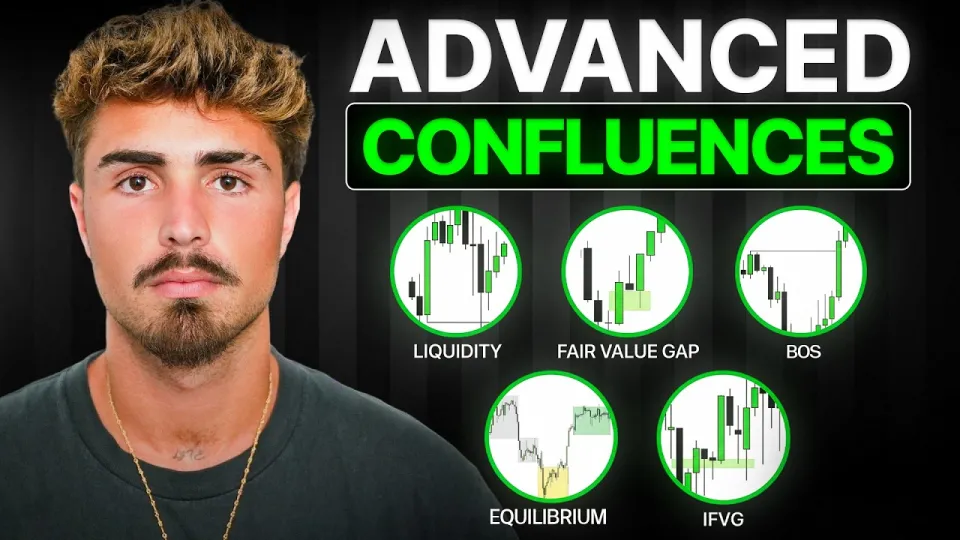
Video: Learn Every Trading Confluence In 18 Minutes
You can order the same kind of articles for your own video to boost it on YouTube and Google. Just message the Telegram bot @sat_sit_bot. It writes articles around your video, embeds the video and publishes them on popular niche websites (no ads). Free trial — 50 articles.
· based on the channel TJR
Key takeaways
- A confluence is any additional factor that confirms a trade idea: a liquidity level, a fair value gap, a break of structure, an equal high or low.
- TJR's 18-minute breakdown covers five core confluences: liquidity, FVG, inverse FVG, equal highs/lows and BOS.
- More confluence is not automatically better: signals that measure the same thing add no value and only encourage overtrading.
- A practical ceiling is two or three independent confirmations on one timeframe, plus a defined stop and target.
- The full system TJR points viewers to is available at go.tjrtrades.com/blueprint-nviugv1.
Trading confluence means combining several independent signals — a liquidity level, a fair value gap, a break of structure, an equal high or low — so that they point to the same trade instead of contradicting each other. The point is not to collect as many confirmations as possible, but to stack factors that measure different things: where price is likely to react, who is trapped on the wrong side, and where the structure has already shifted. TJR's 18-minute walkthrough of every major confluence is a useful checklist, and the paid system behind it is available through the TJR Blueprint.
What counts as a confluence in trading
A confluence is any factor that raises the probability of a setup working, and it only counts if it can be checked before the entry rather than explained afterwards. In the TJR breakdown the list is built around price action on a single chart: liquidity pools, fair value gaps, inverse fair value gaps, equal highs and equal lows, and break of structure. Each one answers a different question — where stops sit, where price moved too fast, where a level has already failed, and whether the trend has actually turned.
A quick way to sort them:
- Location factors — liquidity above or below a swing point, equal highs and lows, session highs and lows. These tell you where price is likely to be drawn.
- Imbalance factors — fair value gaps and inverse fair value gaps. These tell you where price moved inefficiently and may return.
- Structure factors — break of structure and the shift that follows it. These tell you whether the current direction is still valid.
If two items on your list always appear together, they are one confluence, not two. Equal highs and a liquidity pool above them are the same observation described twice.
The five confluences TJR walks through
TJR structures the video as a fast pass over five concepts, and the value is in seeing them as one toolkit rather than five separate strategies. Liquidity comes first because it defines the target: clusters of stops above equal highs or below equal lows are where price often accelerates. Fair value gaps come next — a three-candle imbalance where price skipped a range, which later acts as a magnet or a rejection zone. The inverse fair value gap is the same zone after price has traded through it, flipping its role from support to resistance or the reverse. Equal highs and equal lows mark obvious levels where resting orders accumulate. Break of structure closes the list: a decisive close beyond a prior swing confirms that control has changed hands.
None of these is a signal on its own. A fair value gap in the middle of nowhere is noise; the same gap sitting at a liquidity level, in the direction of the last break of structure, is a setup. That layering — location, imbalance, structure — is what the word confluence actually describes.
How many confluences are enough
Two or three independent confirmations are usually enough for a trade, and adding more tends to hurt rather than help. The most-liked comment under the video makes the point directly: the skill is knowing which confluences actually add value to your strategy. A trader who needs six boxes ticked before entering will take very few trades, and the ones they take will often be late, after the move has already started.
A workable filter looks like this:
- One location confluence, such as liquidity resting above an equal high.
- One structure confluence, such as a break of structure in the direction you want to trade.
- One optional imbalance confluence, such as an unfilled fair value gap between the entry and the target.
- A predefined invalidation point and a target at the next opposing liquidity pool.
If a setup needs a fourth or fifth factor to look convincing, the honest reading is that the first three were weak.
Common questions traders raise about confluences
Most doubts around this topic come from the gap between knowing the terms and executing them under pressure. Viewers regularly ask how to tell a real break of structure from a wick, whether a fair value gap has to be fully filled, and how to stay disciplined when a setup looks perfect but the risk is too large. The recurring theme in the comments is that the concepts are simple to name and hard to apply consistently — one viewer noted turning an 18-minute video into an hour of notes, which is a fair description of how much repetition the material needs before it becomes automatic.
A second theme is expectations. Comments range from claims of turning a small account into a large one in a week to blunt advice that most traders lose money at first and that social media hides the losing streaks. Both are worth reading as a warning about sample size: a handful of good trades proves nothing, and a strategy built on five stacked confluences cannot be judged on ten outings. Track your setups in a journal, tag which confluences were present, and compare win rate and average risk-to-reward across tags before adding or removing anything.
Mistakes that make confluence stacking useless
Stacking confluences fails when the factors are correlated, when they are applied across mismatched timeframes, or when they are used to justify a trade you already wanted to take. Marking three fair value gaps on the same leg and calling it triple confirmation is the classic error — it is one imbalance observed three times. The same applies to a break of structure that is really just a wick through a swing low, or an equal high that is not actually equal within a few ticks.
Practical rules that prevent this:
- Define each confluence in writing before the session, including what invalidates it.
- Use one timeframe for structure and one for entry, and do not mix them mid-trade.
- Cap the number of confirmations you require, and log every skipped setup to see whether the filter helped.
- Size the position from the stop distance, not from how good the setup looks.
Risk control matters more than the count. Day trading is risky and most day traders lose money, which is why the invalidation level and position size deserve more attention than a sixth confirmation.
Useful links
- TJR Blueprint — the full trading system
- Indicators TJR uses daily
- Funded account raffle entry
- Alpha Futures funded accounts — 10% off
- Lucid Trading — 40% off
Bottom line on trading confluence
Trading confluence works when each factor tells you something the others do not: where the stops are, where price moved inefficiently, and whether structure has shifted. Two or three independent confirmations plus a defined stop beat a long checklist every time, and the discipline to skip weak setups matters more than the vocabulary. TJR's 18-minute overview is a compact way to learn the five core concepts, and the deeper system behind it is available through the TJR Blueprint. Learn the terms, then spend your effort on repetition, journaling and risk control.
Source: Learn Every Trading Confluence In 18 Minutes · Markdown version
Questions & answers
What is a trading confluence in simple terms?
It is a second or third factor that confirms a trade idea, such as a fair value gap sitting at a liquidity level in the direction of a recent break of structure. A single signal shows a possible entry; a confluence shows why price is likely to react there.
How many confluences should a setup have?
Two or three independent ones are usually enough: one location factor, one structure factor and optionally one imbalance factor. Requiring more tends to produce late entries and very few trades, and correlated signals that describe the same thing do not count as extra confirmation.
Do fair value gaps always get filled?
No. A fair value gap is a zone of inefficient pricing, not a guarantee of a retracement, and price can leave gaps unfilled for a long time in a strong trend. Treat it as a potential reaction area and combine it with structure rather than trading it in isolation.
Why do traders lose money even when they know these concepts?
Knowing the terms and executing them consistently are different skills, and most day traders lose money. Without a written rule set, a journal that tags which confluences were present, and position sizing based on the stop distance, a good checklist still produces inconsistent results.